🌈 Colors of the Skincare
From research, we knew only 2 colors had clinical evidence for skin-related benefits: red (620 - 700 nm) for improving circulation and blue (405 - 420 nm) for antibacterial effects.
Then a clinic partner asked us if their LED device worked too - it came with FIVE color modes: red, blue, yellow, green, and purple.
My instinct was obviously no. There’s no clinical data - wait, isn’t purple just red + blue?
That’s what LED screens do, right? They mix red and blue pixels to see purple.
But purple is also on the rainbow. That means it has an actual wavelength (I looked it up to be 380-450 nm, outside of the skin-benefit range).
Why do we experience the same purple? Somewhere in there, the physics understanding of color refused to shake hands with the device-engineering understanding of LEDs.
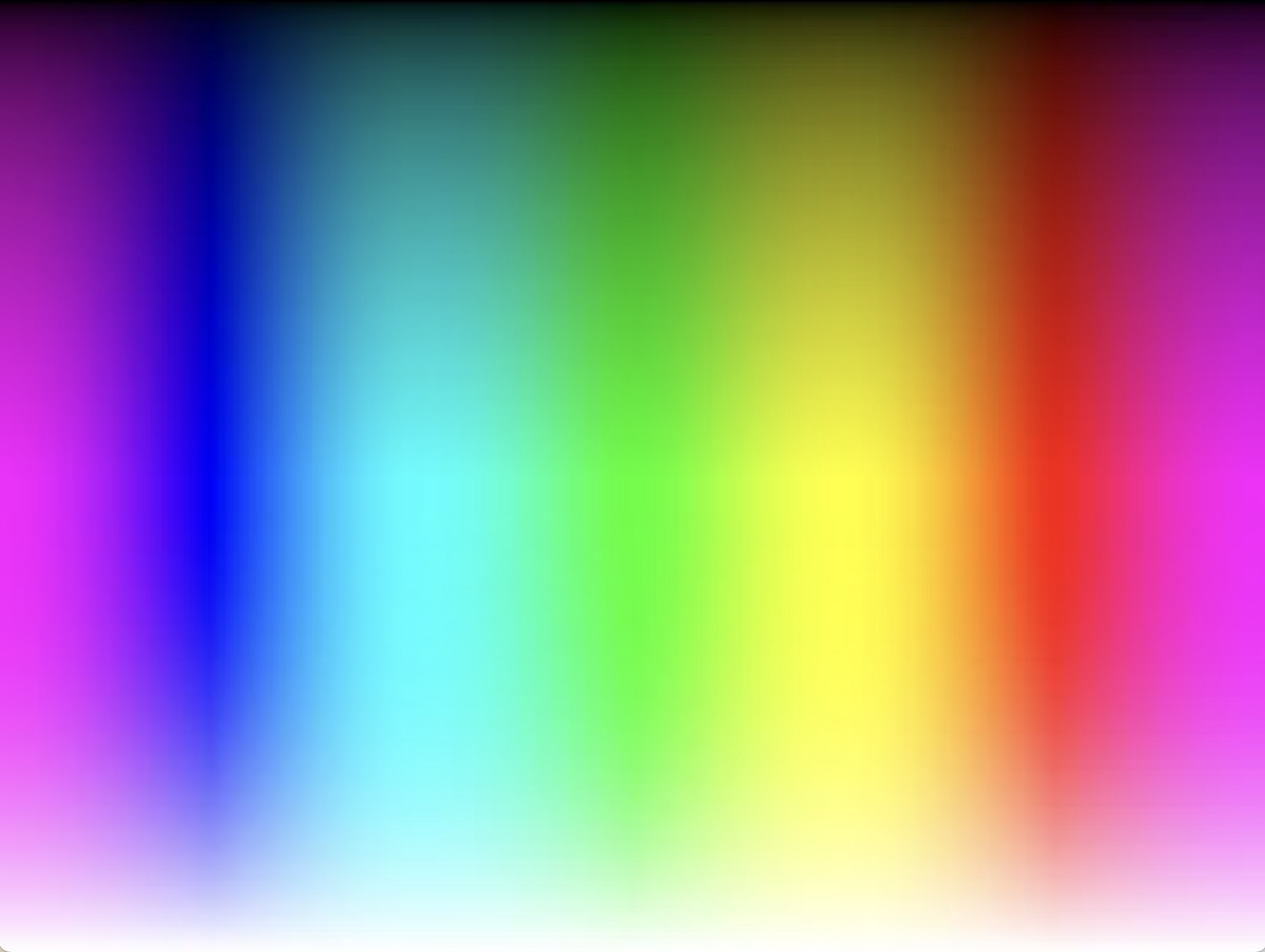
What felt even stranger is that we were able to add colors, when colors are mapped onto a 2D gradient like the image on the left.
So does that mean red and blue act like eigenstates, for which weighted ratios mix to produce new colors? Are they orthogonal axes that define a continuous space of purple shades in between?
Turns out, it’s not the physics, it’s biology taking some shortcuts when designing our eyes.
Our eyes have 3 types of cone cells, each responding to a specific band: 564-580 nm, 534-545 nm, and 420-440 nm. Our brain uses relative activation of these 3 cones to interpret (render) all other colors.
When “564-580 nm” and “420-440 nm” cones are stimulated equally, our perception does the math and we “see” purple.
But this purple is not the real deal, completely different from the 380-450 nm wavelength of spectral purple.
A mantis shrimp would know the difference.
For our poor clinic partner, the answer is it depends. If the purple mode emits spectral purple, then it does nothing for the skin, but if it’s a combo of red and blue LEDs, then their client is getting 2 benefits in 1 session (assuming sufficient irradiance levels.
Somewhere in there is a metaphor for our skin sensors.
Because our perception of products is also similar to a color gradient. For example, hydration seems like a single need, but hydrating products actually come in 3 flavors:
Lightweight & gel-like hydration
Thick, creamy hydration
Nutrient-rich hydration
All labelled as moisturizing, they feel like different shades. What if we map these perceptions into a continuous 2D palette of skin states? Maybe the path to personalization begins with building the right perceptual math to making distinctions visible.